
Solar, storage and hybrid plants for industry, with the switchboards built in our own works.

Free tool for switchboard specification
Busbar size calculator
Enter the bus current and material. See a standard flat busbar section per phase, the number of bars, the resulting current density, the neutral and earth bar sizes and the approximate copper or aluminium weight per metre. Runs in your browser; nothing is uploaded.
This calculator needs JavaScript. If nothing appears below, enable JavaScript or send us your bill and we will run the numbers for you.
Fill in the required figures to begin.
The headline numbers are free. The full breakdown, sizing and payback are emailed to you and unlocked here once you verify your work email.
One-time code to your email, nothing else. We do not share your details.
For bare flat bars in air a conservative design density is about 1.2 to 1.6 A per square millimetre for copper and 0.8 to 1.0 for aluminium, giving a temperature rise inside the limits of IEC 61439. The calculator divides the current by the density, then finds a standard flat section, adding bars per phase where one bar is not enough.
The density rule gives a size; it does not prove the switchboard. Temperature rise, short-circuit withstand and the support spacing that survives the electromagnetic forces in a fault are verified on the busbar system as a whole, which is why we build on Rittal Ri4Power, Siemens SIEPAN and C&S CX systems with design verification to IEC 61439-1 and -2 rather than on a calculation alone.
The neutral is half the phase section in most industrial boards and the full section where harmonic or single-phase loads are heavy. The earth bar is sized for the fault current and duration, typically half the phase section as a minimum.
Indicative sizing only. Short-circuit ratings, support spacing and temperature rise come from the verified system's documentation for the specific design.
Copper for compactness and lower losses, aluminium for cost at high currents where space allows; aluminium bars are about 60 per cent larger for the same current. Both are available on the systems we build.
No. Short-circuit withstand depends on bar support spacing and the enclosure system, and is verified by type test on the busbar system. The fault level calculator tells you what rating to ask for; the system documentation proves it.
Skin effect makes a thick single bar carry current mainly on its surface, so two thinner bars with a gap carry more current for the same metal. Standard systems use laminated bars for exactly this reason.
Enter your monthly electricity bill and see where the money goes, in two minutes.
Solar, storage and hybrid plants for industry, with the switchboards built in our own works.
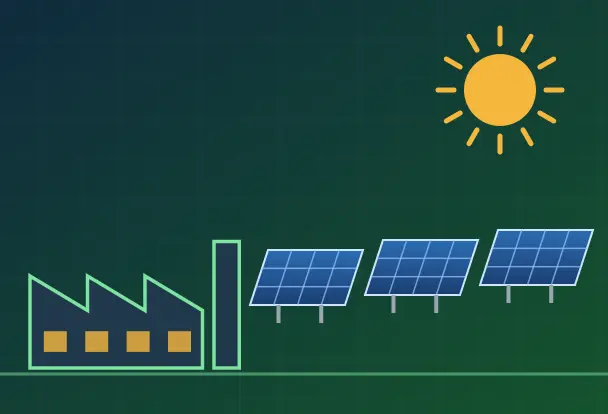
Captive rooftop and ground-mount solar with the electrical side engineered in-house.
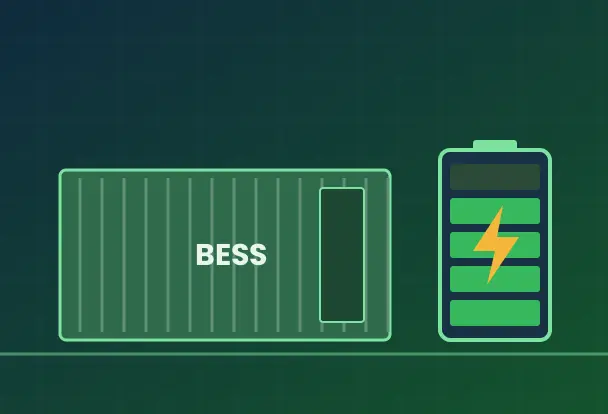
Storage that holds your plant up when the grid drops and trims demand charges.
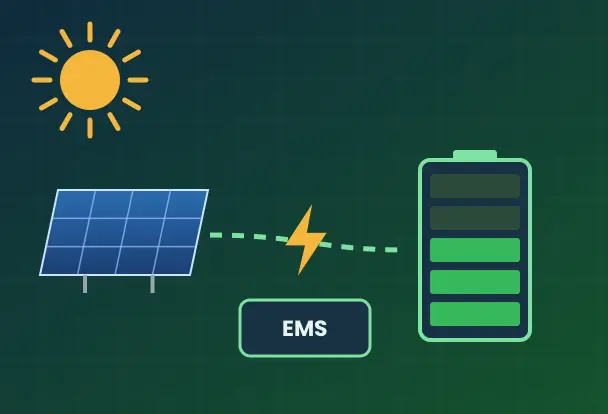
LT switchboards, ACDB, DCDB and protection built and tested in Vadodara.
AC and DC distribution boards for solar plants, from our Vadodara works.