

Solar and battery storage EPC for industrial plants in Gujarat
We build the plant that keeps running during a power cut.
Most storage vendors resell the same imported cabinet. We manufacture the electrical system ourselves at our Kotambi works, factory-test it before it ships, commission it with our own engineers and maintain it with the same team.
Why industrial plants in India are moving now
The gap between what you pay the grid and what you can generate yourself has not been this wide before. Storage is what turns that gap into reliability, not just a lower bill.
Indicative ranges for HT industrial consumers above 500 kVA. Your actual numbers come from your own bills and load profile, which is what the feasibility study is for.
What we deliver
Four packages, one accountable contractor
Design, supply, installation, approvals, commissioning and maintenance under one contract. No subcontracted electrical scope, no finger-pointing at handover.
Solar EPC
Rooftop or ground-mount, sized to your load from a few hundred kWp upward. Design, supply, structure, approvals and commissioning.
Power at ₹2.5–3.5 against ₹7.5–8.5 from the grid
BESS EPC
Behind-the-meter storage sized to your peak and your backup need. Racks, PCS, our own BESS PCC and EMS.
Cuts billed kVA, replaces DG running, holds the critical bus
Hybrid EPC
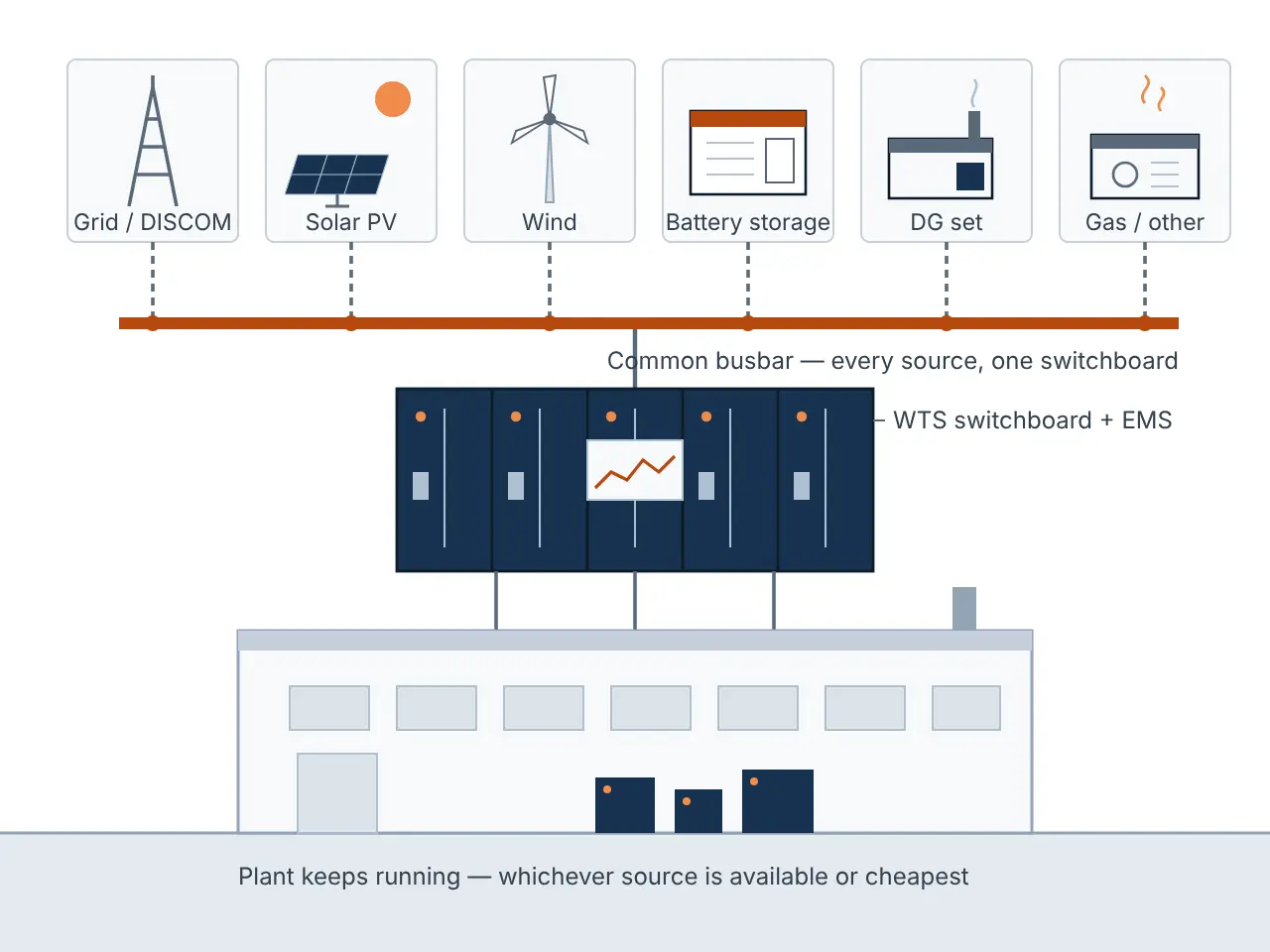
Solar and storage under one EMS, with grid and DG synchronisation and tested islanding.
Maximum self-consumption, near-zero DG hours, ride-through
Electrical BoP
ACDB, DCDB, PCC, busduct, container fit-out and EMS panels supplied to other EPCs and OEMs.
Built and tested at Kotambi, shipped ready to install
The difference
Four jobs. We do all four.
Most suppliers do one or two of them and subcontract the rest. We keep all four in our own hands, and you can verify it by walking through our factory.
We manufacture
The switchboards, protection and EMS panels are made in our own works, which is 20 to 30 per cent of your project.
We test
Factory acceptance testing at Kotambi before dispatch, with your engineer present if you want.
We commission
Protection coordination, islanding test, EMS tuning and DISCOM synchronisation by our own engineers.
We maintain
The same team holds the AMC, monitors the plant and reports measured performance every month.
| What decides whether your plant holds | How Wisdom Techno Solutions handles it |
|---|---|
| Electrical system | Switchboards, protection and EMS panels manufactured at our own works at Kotambi, not bought in |
| Protection and islanding | Designed, coordinated and witness-tested by our own engineers before dispatch and again at site |
| Right-sized projects | Plants from a few hundred kVA upward are our core business, engineered to order, never a side line |
| Site response | Same-day attendance within 250 km of Vadodara by the engineers who built the system |
| Who holds the AMC | The same commissioning team, with spares already stocked for every standard configuration |
Standard systems
Four configurations that cover most plants
Standardised designs mean a faster quotation, a drawing set we have built before, and spares we already stock. Anything outside these we engineer to order.
| Configuration | Suits | Action |
|---|---|---|
| 125–250 kW / 261–500 kWh cabinet with our interface panel and EMS | 250–750 kVA plant with trips and DG pain | Ask for pricing |
| 1 MW / 2 MWh container, grid-forming PCS, WTS BESS PCC and EMS | 1–3 MVA plant | Ask for pricing |
| 2 MWp solar with 1 MW / 2 MWh storage, critical-bus switchboard and EMS | 1.5–5 MVA plant with roof or land | Ask for pricing |
| 1 MWp rooftop solar, string inverters, WTS ACDB and PCC, zero export | Any plant with about an acre of roof | Ask for pricing |
Prices depend on site conditions, cable runs and approval scope, so we quote against your single-line diagram rather than publishing a rate. Ask and you will have an indicative figure the same week.
Free engineering tools
Work out your own numbers first
No registration to run them, no sales call unless you ask for one. These are the same calculations our estimation team starts with.
Electricity bill analyser
Put in your HT bill and see your true landed cost per unit, how much of it is demand charge, what the power-factor penalty is costing you, and how your consumption splits across time-of-day slabs.
Analyse my billDG replacement calculator
Enter your DG rating, monthly running hours and diesel rate. You get your real cost per unit on DG, the storage size that would replace most of it, and the payback in months.
Size my storageThree more free tools, for demand charges, solar and storage payback, and power factor, are on the free tools page. Indicative calculation; verify with engineering before ordering.
How a project runs
Ten stages, each with a gate
- QualifyBills and load profile reviewed
- FeasibilitySite visit and sizing, three days
- ProposalPackage, SLD and savings basis
- OrderContract signed
- EngineeringYield study, protection, drawings
- ProcurementTwo approved vendors per item
- Factory and FATPanels built and tested at Kotambi
- Site worksElectrical by us, daily safety brief
- CommissioningIslanding test and DISCOM sync
- Handover and AMCAs-built, training, monitoring live
Free feasibility study
Send us twelve months of electricity bills and we will tell you what is worth doing, including when the answer is nothing.
- Your real landed cost per unit, broken down
- Solar and storage sizing against your load profile
- Indicative single-line diagram and budget figure
- Three working days, no obligation
Prefer to talk? Call +91 80002 29727, weekdays 9 am to 7 pm.
Tell us your company, location, contract demand (kVA) and whether you want solar, storage or both.
We use your details only to reply to this enquiry. We do not share them.
Questions we are asked first
How long does a battery last?
The LFP racks we use carry the manufacturer's warranty, passed through to you back-to-back in writing. We do not use NMC chemistry in industrial installations.
What about fire safety?
Racks are UL 9540A tested, laid out to NFPA 855 clearances, with suppression and detection designed in and signed off by your insurer before we install.
Do I need to export to the grid?
No. We design for self-consumption, which is also the direction current GERC rules push. Any export is treated as upside, never as the basis of your payback.
Can you work with our existing solar?
Yes, and it is a common starting point. Adding storage to an existing plant usually improves its economics more than adding more panels would.
Is there an option without capex?
We can introduce you to financing partners who own the asset and sell you the power. We build and maintain the plant either way.